


Re-Digging Abraham’s Wells

There have been trillions and trillions of events that we don't read about in the Bible because the writers weren't inspired by G-D to include them. That should cause us to realize that if something was included in the Scriptures, it was included for a purpose. That purpose is to teach us something about G-D or about ourselves. So, when I read through the pages of Scripture, I first read them as a narrative that shares our history. Then I reread the same chapters and verses to see what G-D is trying to teach me about Himself, about me, or about us.
I recently read the following words from Genesis 26:18:
"Then Isaac dug again the wells of water that had been dug in the days of his father Abraham—the Philistines had stopped them up after Abraham's death. He gave them the same names that his father had given them."
I read these words not only as Isaac's history or the history of the people of G-D, but also as G-D speaking into the season of life that I am currently living in. I read these words as though G-D were speaking directly to me, helping me see how they relate to who I am, where I am, and what I am doing.
I have been studying and writing a book about our identity as believers, trying to explain how we can become unified without losing our G-D-given distinctions, how Jews and non-Jews can live fruitfully side by side without either seeing themselves as more chosen or less chosen than the other.
Deuteronomy 7:6: "For you are a holy people to Adonai your God—from all the peoples on the face of the earth, Adonai your God has chosen you to be His treasured people."
Isaiah 43:10: "'You are My witnesses,' it is a declaration of Adonai, 'and My Servant whom I have chosen, so that you may know and believe Me, and understand that I am He. Before Me no God was formed, and there will be none after Me.'"
Psalm 33:12: "Blessed is the nation whose God is Adonai, the people He chose for His own inheritance."
Colossians 3:12: "Therefore, as God's chosen people, holy and dearly loved, clothe yourselves with tender compassion, kindness, humility, gentleness, and patience."
John 15:16: "You did not choose Me, but I chose you. I selected you so that you would go and produce fruit, and your fruit would remain. Then the Father will give you whatever you ask in My name."
Chosen indicates purpose, role, responsibility, and calling—not hierarchy.
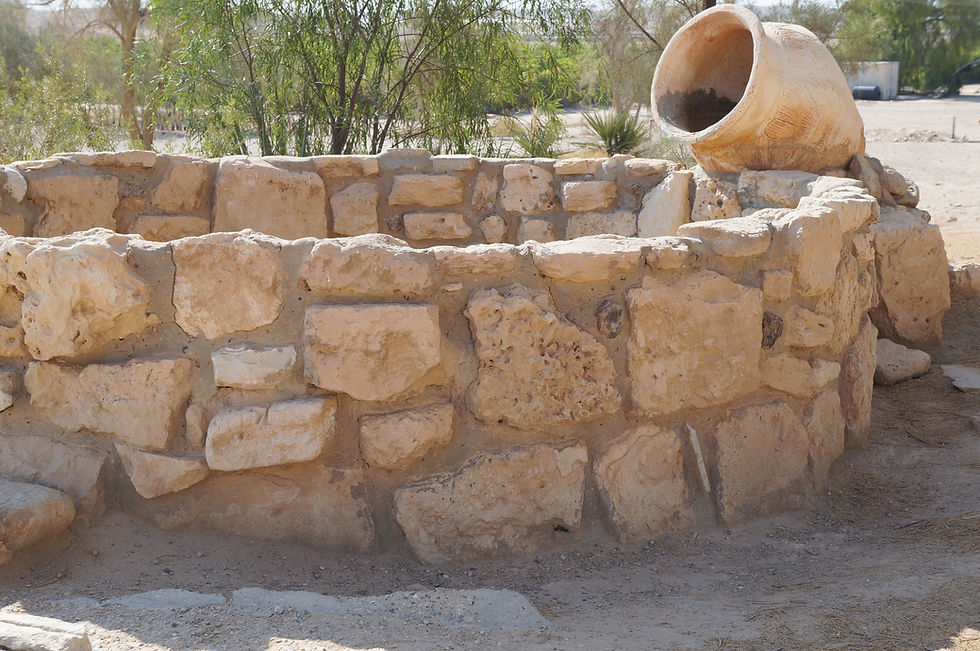
As I read the words of Genesis 26:18, I thought about the fact that Isaac didn't simply follow his father's example by digging new wells. He redug the wells his father had dug. He wanted water from the same source from which his father had drunk.
If we treat the well figuratively and symbolically, as Scripture often does when referring to the refreshing waters of G-D's Spirit, we notice something significant. At the beginning of Genesis 26, although Isaac is hearing from G-D, he is still experiencing the tension between completely trusting G-D and merely following the example of his father Abraham. While Isaac has received G-D's covenant promises, he repeats Abraham's mistake. Instead of trusting G-D, Isaac follows his father's example and lies about his wife, claiming she is his sister, just as Abraham had done.
Thankfully, G-D rescues Isaac and Rebekah. At that point, we begin to see Isaac fully embrace the things of G-D. He does so not by digging new wells for himself but by restoring the wells Abraham had once dug and named, giving them the very same names Abraham had given them.
Isaac desired the fullness of the covenant promises that were his inheritance, and he knew how to receive them because G-D had already told him personally in Genesis 26:4-5:
"I will multiply your seed like the stars of the sky, and I will give your seed all these lands. And in your seed all the nations of the earth will continually be blessed, because Abraham listened to My voice and kept My charge, My mitzvot, My decrees, and My instructions."
Isaac understood that in order to faithfully inherit and live within the blessings of G-D's covenant promises, the key was not simply to imitate Abraham's actions, including his failures, but to imitate Abraham's faithfulness in obeying G-D. After all, G-D said He would bless Isaac because Abraham listened to His voice, kept His charge, His mitzvot, His decrees, and His instructions. If Isaac wanted that inheritance to continue, he too would have to listen and keep those same things.
As I mentioned earlier, my studies and writing have been focused on what this looks like in our lives today because we all desire to experience G-D's covenant blessings and to walk as His chosen people, recognizing that our chosenness may differ just as our callings and responsibilities differ.
Now that I have laid the foundation for the lens through which I have been viewing this passage, let me clarify a bit further.
I believe the modern Messianic Jewish movement is much like Isaac realizing that although our fathers were given Torah, they did not always demonstrate unwavering faith in G-D. As a result, they sometimes left us poor examples to follow, while our enemies filled in the wells that once provided life-giving water. Those filled-in wells have often kept us from drinking the fresh water of the Spirit as Abraham once did.
Once we recognize that our blessings flow through the wells of G-D's covenants and acknowledge our own unfaithfulness, or at least our partial unfaithfulness, we also realize our need to redig Abraham's wells.
This is where my thoughts truly begin and where I see these verses speaking directly to us today.
As Isaac began to redig the wells, the first one he encountered was named Esek, which means "quarreling" or "contention." This reminds me of how as the modern Messianic movement began uncovering these ancient wells, the first thing we seemed to do was argue among ourselves. We argued about observance, traditions, Hebrew in services, liturgy, non-Jewish involvement, organizational structures, what we should call ourselves, and the list goes on. The truth is that, in many ways, we are still digging out that first well.
The second well was called Sitnah, meaning "opposition" or "enmity." As we began digging this well, we found ourselves opposed by the Jewish community, which often would not accept us as Jews or as part of Judaism, even though we were reclaiming our heritage and inheritance. We were also opposed by the Christian community, much of which was not enthusiastic about Abraham's wells being reopened because many believed those wells should have remained buried. After all, many believed the inheritance no longer belonged to Abraham's physical descendants but only to his "spiritual" children. There is little question that we are still digging out this well as well.
The third well was named Rehoboth, meaning "broad places" or "room." As Isaac finished digging this well, he declared, "Now the Lord has made room for us, and we shall be fruitful in the land."
This is the well that most captures my attention because I believe it is where G-D desires us to be.
It is a place where we are no longer quarreling among ourselves over our differences or our chosenness, while at the same time acknowledging that G-D intentionally created us with distinct callings, identities, and responsibilities. Rehoboth is also a place where we are no longer consumed with defending ourselves against those outside our movement who neither understand why we are redigging these wells nor desire for us to do so.
Rehoboth is a well with room for distinctions and differences within our movement, provided we do not compromise what G-D's Torah teaches. Rehoboth has room for both Jews and non-Jews to participate equally in what Paul called the Commonwealth of Israel. It provides space for Jews to walk fully in our heritage and chosenness while also allowing non-Jewish believers to walk fully alongside Jewish believers without being treated as outsiders or as somehow less chosen by G-D.
Jews and non-Jews have been chosen by G-D for different roles and different purposes within the body of Messiah. Yet, our chosenness is not hierarchical because G-D shows no partiality toward His people. Our chosenness is based solely upon the purposes for which each of us has been chosen.
It is my hope that the Messianic movement will complete redigging all three of these wells soon so we can dwell together as one which is, after all, what Yeshua prayed for in John 17:21. May we no longer be fighting among ourselves, no longer fighting outside adversaries, and making room for one another with love and grace.


Comments