


Forgiveness: More Than Just Saying, “I Forgive You”

How many times have we heard someone say, “You just need to forgive them?” I have heard those words many times throughout my life. Sometimes they are spoken by someone who genuinely wants to help. Sometimes they are spoken because forgiveness sounds like the right answer to a difficult situation.
I have discovered that forgiveness is not always as simple as saying, “I forgive you.” If forgiveness were simply a matter of voicing those three words, why does Scripture have so much to say about repentance, restoration, responsibility, and forgiveness? Perhaps we have made forgiveness easier than the Bible does.
The Scriptures are not simply unrelated or isolated stories. Every story is part of the greater story of G-D's redemptive plan. So when we read about forgiveness in the Tanakh, we see the same G-D we encounter in the Brit Chadashah. He is not the “G-D of the Old Testament” who is angry and judgmental and then suddenly mellows with age to become the G-D of grace and forgiveness in the New Testament.
He has always been a G-D of mercy. He has always been a G-D who forgives. And He has always also been the G-D who calls His people to repentance. This is important to understand because sometimes we separate forgiveness from repentance. We want forgiveness, but we don't necessarily want the repentance that goes with it. Yet, throughout Scripture, forgiveness and repentance are repeatedly connected.
Acts 3:19 tells us: “Repent, therefore, and return—so your sins might be blotted out,”
Repent and return. There is movement involved. Biblical forgiveness is not simply G-D saying, “Don't worry about what you did.” It is G-D saying, “Turn around. Come back. I am providing a way for you to be restored.”
There is another statement I hear quite often: “You need to forgive yourself.” Have you ever noticed that Scripture never actually commands us to forgive ourselves? We are commanded to forgive others. We are told that G-D forgives us. But nowhere are we told that we must forgive ourselves.
Why is that important? Because sometimes what we call “forgiving ourselves” is really our refusal to accept G-D's forgiveness. We continue to carry a burden that G-D has already offered to remove.
Paul tells us in 2 Corinthians 5:17: “Therefore if anyone is in Messiah, he is a new creation. The old things have passed away; behold, all things have become new.”
Think about that for a moment. If we are in Messiah, we are a new creation. That doesn't mean our past didn't happen. It means our past no longer has the authority to determine who we are. Our forgiveness does not come from us. It comes from G-D through Messiah Yeshua.
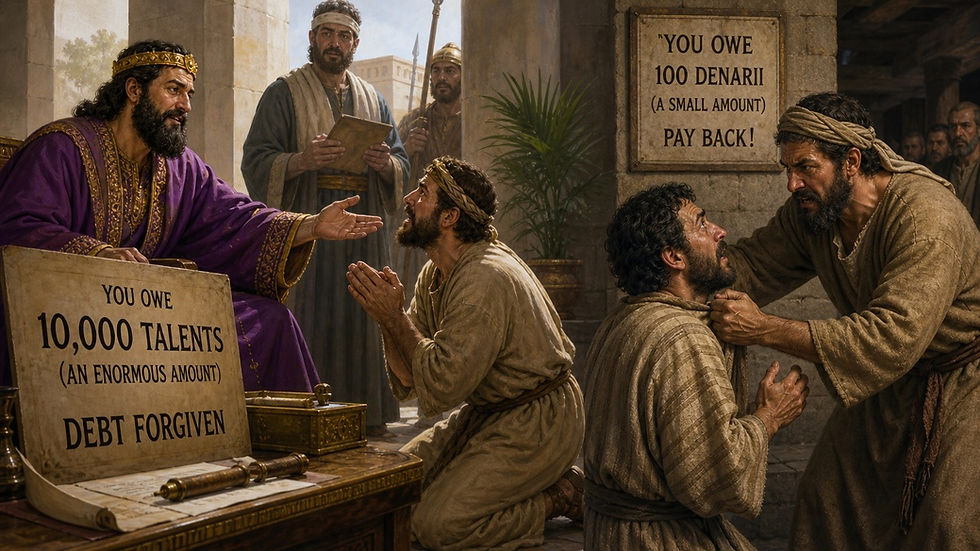
Our responsibility is to receive that forgiveness and then begin living as forgiven people. This is where forgiveness becomes particularly interesting. We often talk about forgiveness as though it is simply something we receive. But throughout Scripture, receiving mercy also brings responsibility.
Consider Israel. G-D chose Israel, redeemed Israel, forgave Israel, restored Israel, and called Israel to be a kingdom of priests. Being chosen was a blessing. But it was also a responsibility.
Exodus 19:6 says: So as for you, you will be to Me a kingdom of kohanim and a holy nation.’ These are the words which you are to speak to Bnei-Yisrael.”
The same principle applies to us as followers of Yeshua. We have received mercy. We have received forgiveness. We have received redemption. Therefore, we have a responsibility to extend mercy, forgiveness, and redemption to others.
Yeshua makes this very clear in Matthew 6:14: “For if you forgive others their transgressions, your heavenly Father will also forgive you.”
Notice that Yeshua didn't say, “Because you have been forgiven, you can now hold everyone else accountable for everything they have ever done to you.” He tells us to forgive. Forgiving is our responsibility. But there is another mistake we can make. Sometimes we believe that if we truly forgive someone, there can no longer be any accountability. That isn't biblical either. Forgiveness and accountability are not opposites.
In fact, genuine grace should lead us toward responsibility. If I hurt someone, saying “I'm sorry” doesn't automatically repair everything that was damaged. If I break someone's trust, forgiveness doesn't necessarily mean trust is immediately restored. If I damage a relationship, I may need to take responsibility for my actions and allow time for that relationship to heal. G-D can forgive our sin immediately, but sometimes the consequences of our choices continue.
David is a good example of this. G-D forgave David, but forgiveness did not mean that every consequence of David's actions disappeared. We need to understand the difference between forgiveness and consequences. Forgiveness means I am no longer holding your sin against you. It does not necessarily mean that every consequence of your actions disappears.
Now we come to the difficult part. What do we do when someone has hurt us? This is where forgiveness becomes more than a theological concept. It becomes personal. Someone has lied about us. Someone has betrayed us. Someone has broken our trust. Someone has said something that we will probably remember for the rest of your life. What does G-D expect us to do? He expects us to forgive.
But forgiveness doesn't mean that what happened was acceptable. Forgiveness doesn't mean that we pretend it didn't happen. Forgiveness doesn't mean that we immediately trust someone who has previously demonstrated that they cannot yet be trusted. And forgiveness doesn't mean that we remove every healthy boundary. Forgiveness means that we surrender our desire for personal vengeance. We allow G-D to be G-D.
Romans 12:19 reminds us: “Never take your own revenge, loved ones, but give room for God’s wrath—for it is written, “Vengeance is Mine; I will repay,” says Adonai.”
Sometimes forgiveness can be less about what happens to the person who hurt us and more about what happens inside of us. Because bitterness can become a prison. Many times the person who hurt us has moved on with their life while we continue to live in the prison of feelings we have created because of their actions. Yeshua did not set us free so that we could spend the rest of our lives imprisoned by our response to someone else's sin.
There is a beautiful picture of restoration in the story of Lazarus. Yeshua called Lazarus out of the tomb. Lazarus was alive. But there was a problem. He was still wrapped in grave clothes. Yeshua had brought him back to life, but the community still had a responsibility to help remove those things that were still binding him. I believe there is a lesson here for the Body of Messiah.
When someone TRULY repents and is restored, our responsibility is not to continually remind them of who they used to be. Our responsibility is to help them walk in the new life they have received. Sometimes people are forgiven but never restored. They are told, “Yes, we forgive you,” while everyone continues to look at them through the lens of their past.
That is not the fullness of restoration. If G-D has forgiven someone, who are we to continually remind them of the grave they came out of? We should help remove the grave clothes. We should remind people of what Scripture says about forgiveness. We should remind them that they are a new creation. We should help them see themselves as G-D sees them. And sometimes we do that simply by loving them.
There may be times when we don't feel like forgiving. In fact, there may be times when everything inside of us says, “They don't deserve forgiveness.” But perhaps that is the point. Forgiveness isn't based on whether someone deserves it. If forgiveness were based upon deserving it, none of us would have hope. We didn't earn G-D's forgiveness. We received it because of His mercy and grace. Therefore, we are called to extend that same mercy to others.
That doesn't mean there should be no accountability. It doesn't mean there should be no consequences. It doesn't mean we ignore sin. It does mean that we refuse to allow someone else's sin to determine the condition of our heart.
So, what are we supposed to do? Maybe forgiveness begins with a simple prayer: “Avinu Malkeinu, help me forgive. Help me forgive the person who hurt me. Help me forgive the person who betrayed me. Help me forgive the person who disappointed me. Help me forgive the person who never apologized.”
This prayer doesn’t change the person who hurt, betrayed, disappointed or never apologised, but it can change us. They still need to repent and be accountable to G-D for their actions. It is impossible to ask for forgiveness and repent for someone else.
And perhaps we also need to pray: “G-D, help me receive the forgiveness which You have already provided to me.”
Sometimes we are much better at asking G-D to forgive us than we are at believing that He actually has. If you have repented, turned back to G-D, and have placed your trust in Messiah Yeshua, then don't continue carrying the non-existent burden that He has already removed. Receive His forgiveness. Walk in His forgiveness. And then give what you have received.
Because forgiveness is not simply something G-D does for us. It is something G-D wants to do through us. We have been forgiven so that we can become people who forgive. We have been restored so that we can help restore others. We have received mercy so that we can show mercy. And we have been set free so that we can help others remove the grave clothes that continue to bind them. That is what forgiveness looks like when it becomes more than just saying, “I forgive you.”


Comments